The traditional workforce planning playbook no longer works. For years, CHROs and talent leaders relied on resumes and managerial intuition to assess capability. They reviewed job titles, academic backgrounds, and experience to predict performance.
Today, that approach creates serious business risk.
We are now facing a global skill intelligence crisis. Rapid advances in automation and generative AI are changing skill requirements faster than traditional systems can track. Static resumes and outdated assumptions no longer reflect real operational capability.
Organizations often lack visibility into:
- What employees can actually do today
- What future roles will require
- Where hidden skill gaps are reducing productivity
To navigate this shift, enterprises must move from backward-looking talent proxies to objective, data-driven workforce intelligence.
The Expiration Date of Modern Skills
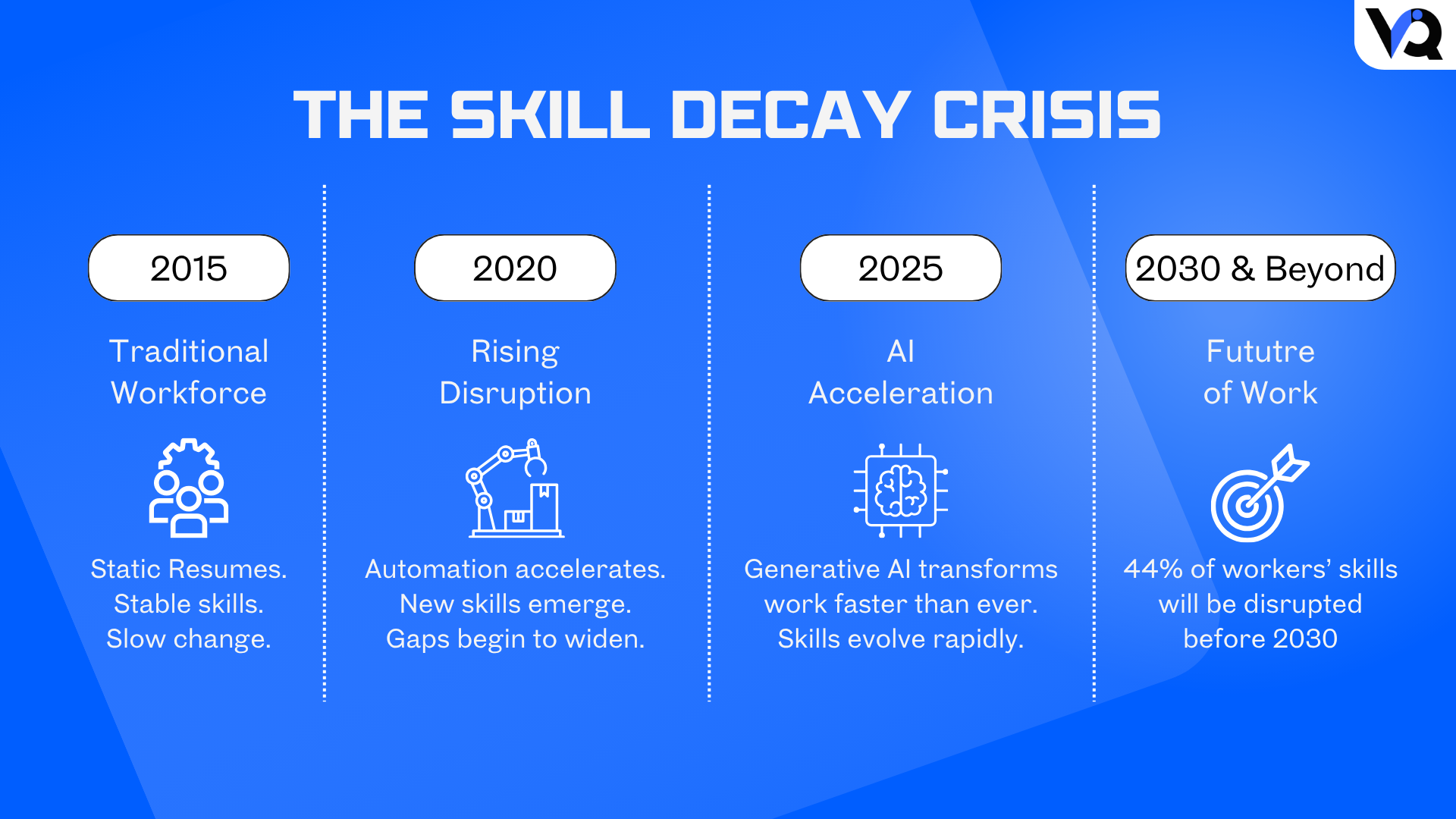
The biggest driver of this crisis is the rapid decay of technical and functional skills. A resume only captures past experience. It cannot show how skills evolve with changing business demands.
According to the World Economic Forum, employers estimate that 44% of workers’ skills will be disrupted before 2030.
Deloitte research also shows that corporate skill requirements have already changed by nearly 25% since 2015, with the pace expected to increase further by 2027.
When nearly half of workforce capabilities risk becoming outdated within a few years, static evaluation systems create major operational gaps. Business priorities change quickly, but traditional talent management remains tied to historical job records.
The Failure of Intuition-Based Governance
When resumes fail to provide clarity, organizations often rely on managerial intuition. But unstructured, gut-based evaluations are highly subjective and poor predictors of execution capability.
A long-term study by McKinsey & Company found that validated, skills-based assessments are:
- 5x more predictive of job success than formal education
- Over 2x more predictive than past work experience alone
Despite this, Gartner reports that nearly 87% of enterprises are already facing, or expect to face, critical skill shortages within the next two years.
The issue is not a lack of talent or training budgets. It is a lack of workforce intelligence.
Without a standardized and dynamic skills framework, organizations:
- Miss high-potential internal talent
- Repeat unnecessary hiring cycles
- Struggle to assign the right people to strategic initiatives
Beyond the Paradox: A Unified Skills Intelligence Platform
To solve this visibility problem, modern enterprises are moving beyond job titles. They are adopting continuous, multi-dimensional systems that treat workforce capability as a real-time intelligence platform.
This is the challenge KAUSHALL was built to solve.
KAUSHALL is a Human Capital AI platform that creates a unified skills intelligence layer across the workforce lifecycle. Instead of treating skill mapping as an annual HR exercise, KAUSHALL aligns employee capability with live role requirements and business objectives.
It helps enterprises answer four critical questions:
- What skills exist across the organization today?
- What competencies are actually required for operational success?
- Where are the hidden skill gaps and talent risks?
- How can employees be upskilled in a measurable, targeted way?
How KAUSHALL Replaces Guesswork with Multi-Source Data
Effective talent management requires objective workforce telemetry. KAUSHALL replaces subjective evaluation methods with a multi-source intelligence model.
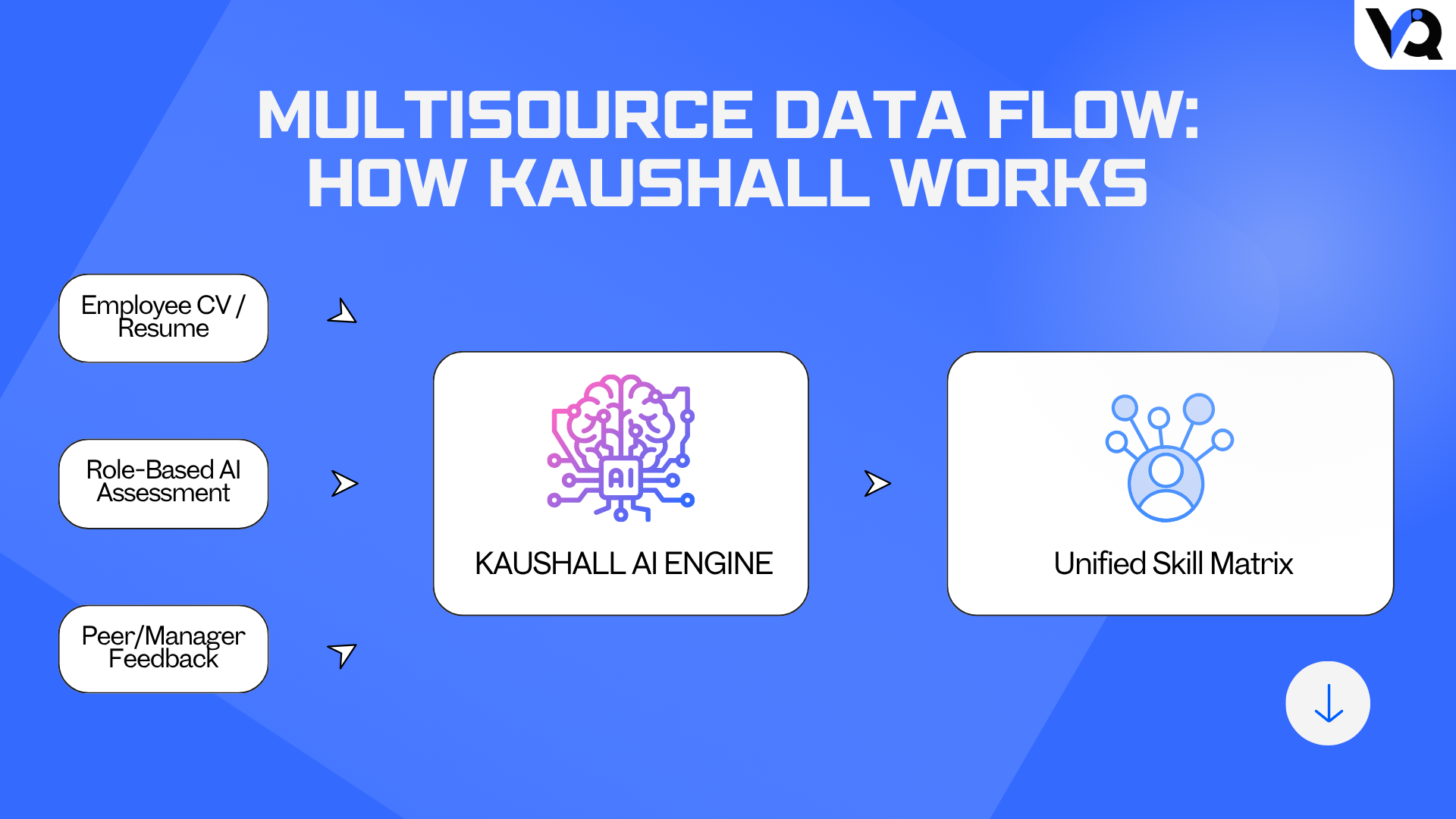
1. Contextualized Role Extraction & Assessment
The platform ingests enterprise job descriptions at scale and automatically assigns Job IDs and role structures.
KAUSHALL’s AI engine extracts:
- Technical skills
- Behavioral competencies
- Role-specific capability requirements
During evaluation cycles, the platform:
- Analyzes employee resumes
- Maps them against assigned job descriptions
- Generates situational assessment questions to evaluate execution readiness
2. Multi-Source Feedback Integration
KAUSHALL avoids rigid rating systems that often create reviewer bias.
Instead, it supports:
- Natural language manager feedback
- Peer-to-peer evaluations
- Contextual free-text reviews
This allows the AI engine to interpret nuanced human insights alongside technical assessment data.
3. The Dynamic Skill Matrix
After each evaluation cycle, the platform combines:
- CV insights
- Assessment performance
- Feedback intelligence
This creates a unified Skill Matrix that provides leadership with real-time visibility into:
- Individual capabilities
- Team-level strengths
- Organizational skill distribution
Interactive dashboards make workforce analytics searchable and actionable.
Closing the Gap with Outcome-Driven Upskilling
Identifying skill gaps is only the first step. The real value lies in closing them efficiently.
Traditional training programs often fail because they rely on generic learning catalogs with little personalization.
KAUSHALL directly connects skill diagnosis to targeted learning outcomes.
The platform integrates with existing learning ecosystems such as:
- Coursera
- Udemy
- Internal enterprise learning systems
Instead of generic recommendations, KAUSHALL generates personalized, role-aligned learning paths based on verified skill gaps.
Progress is continuously tracked and validated across future assessment cycles. This transforms corporate learning from a cost center into a measurable driver of:
- Product quality
- Operational speed
- Service delivery performance
Business Value Realized
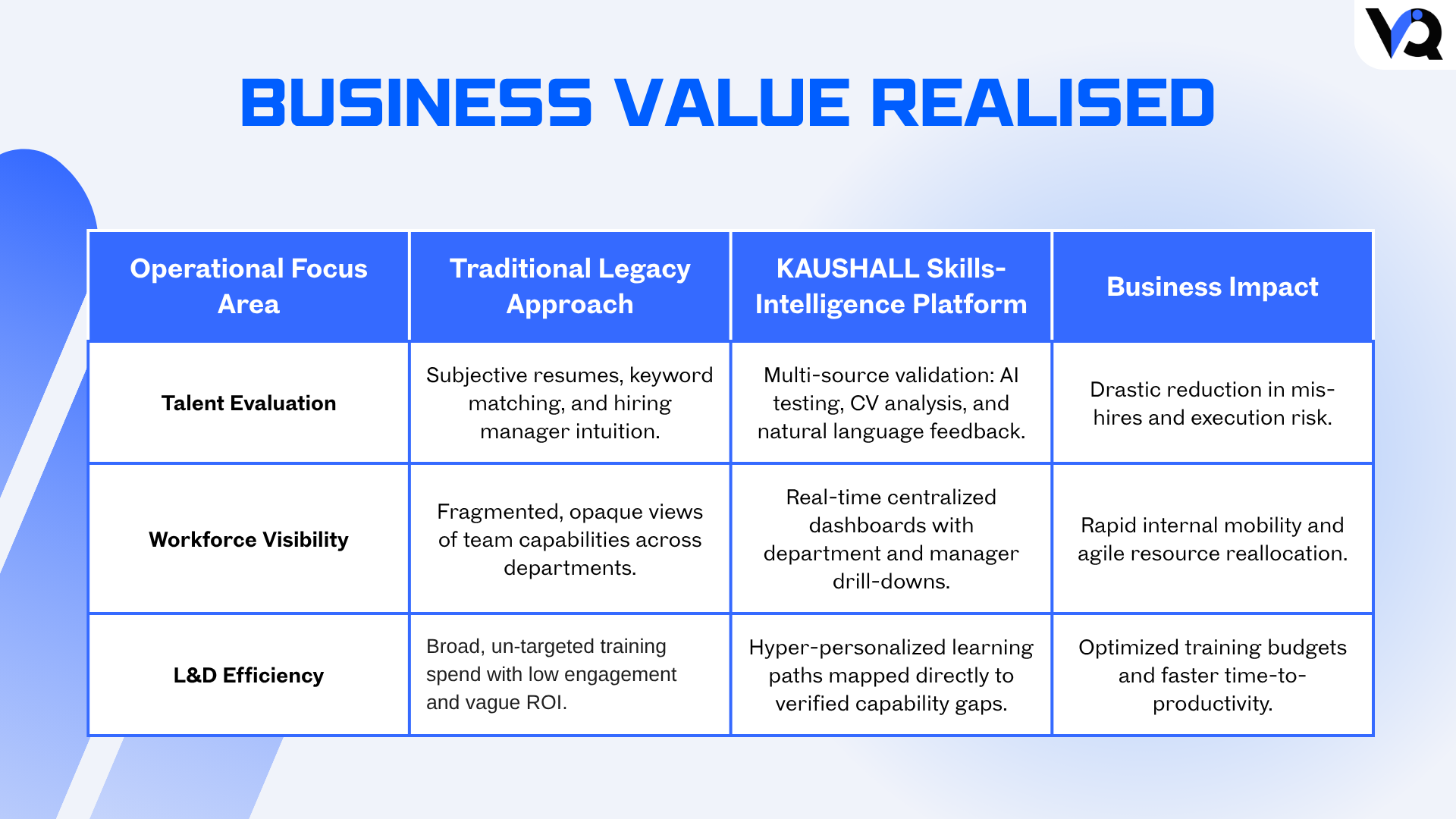
Transitioning from resume dependency to an AI-led, skills-first ecosystem yields clear, quantifiable returns for enterprise leadership:
The Next Era of Talent Intelligence
The skill intelligence crisis cannot be resolved by running the same legacy processes faster, adding more interview rounds, or rewriting static job posts. It requires a fundamental shift in how organizations measure and cultivate human capability.
When talent decisions are backed by continuous, multi-source intelligence, guessing disappears. Businesses stop scaling operational inefficiency and begin building an agile, high-execution workforce designed to scale.
Reference Links & Sources
- World Economic Forum: The Future of Jobs Report
- Deloitte Insights: Navigating the Skills-Based Economy and Corporate Value
- McKinsey & Company: Taking a Skills-Based Approach to Building the Future Workforce
- Gartner: HR Leader Priorities and Managing Enterprise Skill Gaps