When enterprise organizations transition toward a skills-first operating model, they frequently hit a familiar roadblock: data integrity. Chief Human Resource Officers (CHROs) and VPs of Talent quickly realize that a skill matrix is only as good as the inputs used to build it.
To collect this data, legacy HR software traditionally relies on two primary mechanisms: automated keyword screening or employee self-assessments.
Unfortunately, both models are fundamentally flawed. Keyword screening only measures how well a resume is optimized, while self-assessments are notorious for capturing employee confidence rather than actual competence. To unlock true skill intelligence, an organization cannot rely on isolated, single-source data points. True workforce capability can only be mapped through a multi-source validation engine that balances automated testing with contextual feedback from the people who observe the work daily, peers and managers.
The Danger of Single-Source Data in Talent Strategy
Relying on a single source of truth to evaluate human capital creates dangerous operational blind spots. When organizations build skill inventories using unverified employee surveys, they fall victim to severe psychological and structural biases.
The first is the structural imbalance of self-reporting. According to global workforce studies by Deloitte Insights on the Skills-Based Organization, self-assessments introduce massive variance into corporate data lakes. Assertive or overconfident employees routinely overrate their functional expertise, while technically superior but naturally humble professionals underrate their capabilities. Without an objective counterweight, HR leaders end up assigning high-stakes projects based on skewed data.
The second factor is the widespread availability of generative AI. Macro data compiled by Gartner on HR leadership priorities highlights that roughly 87% of enterprises face persistent talent shortages, yet traditional credential and keyword verification methods fail to accurately flag real execution readiness. When a professional can use AI to optimize their listed competencies or memorize answers to generic multiple-choice tests, standard screening models break down entirely.
Why the Boardroom Demands Objectivity
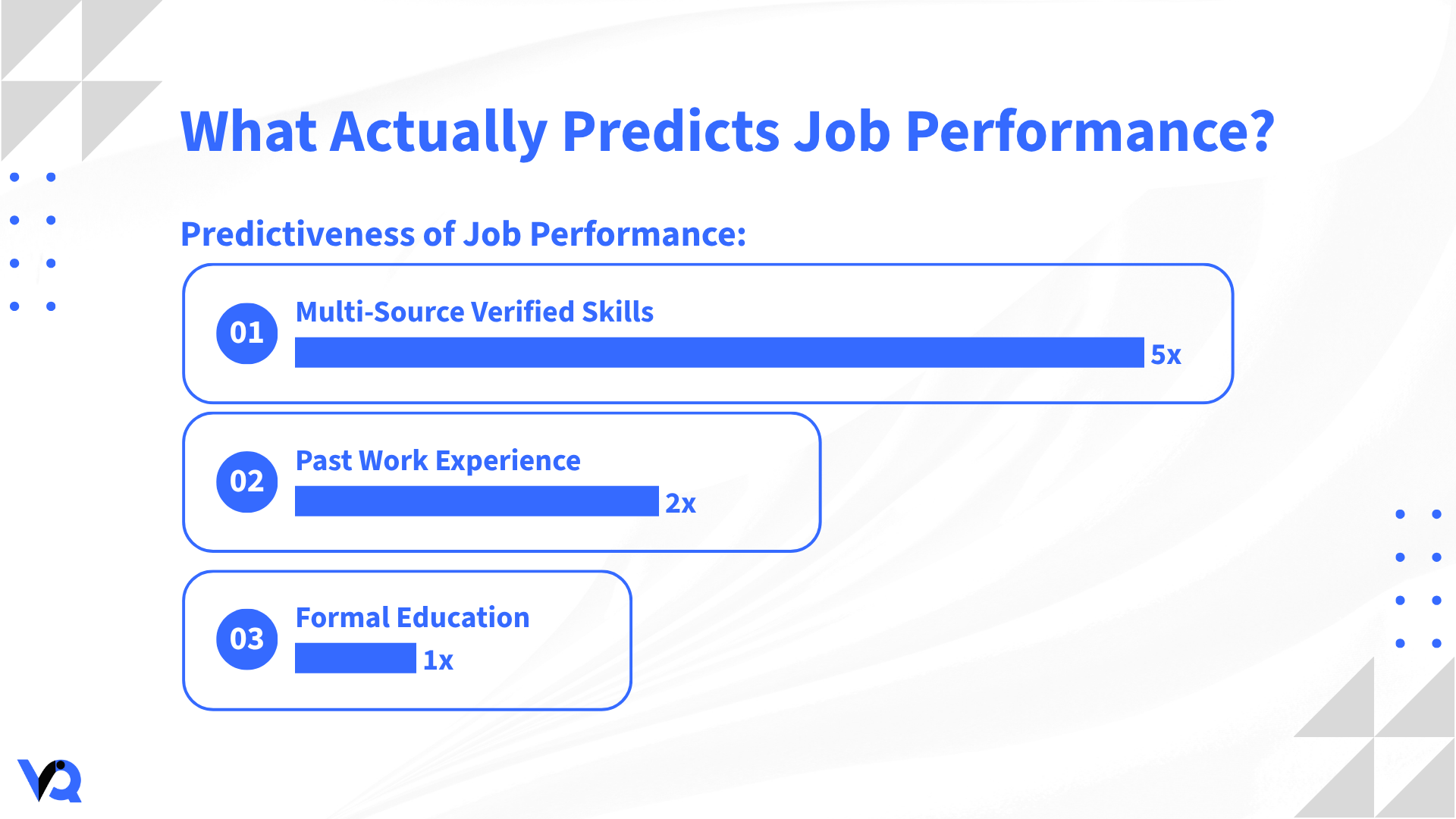
When talent evaluation is subjective, the financial penalty to the business accumulates rapidly. Enterprise research from McKinsey & Company on building the future workforce reveals a profound truth: hiring and promoting based on validated, multi-source skills is five times more predictive of successful performance than formal education, and twice as predictive as past job titles alone.
Despite this reality, many executive teams operate with an opaque view of their internal talent pools. When a business needs to launch a critical product or execute a digital transformation, it often defaults to expensive, redundant external recruitment because leadership cannot verify whether the required adjacent skills already exist within their current teams.
The KAUSHALL Blueprint: Unifying Multi-Source Telemetry
To eliminate subjective bias and unlock authentic data accuracy, forward-thinking enterprises use advanced platforms to build a continuous, multi-dimensional skills inventory.
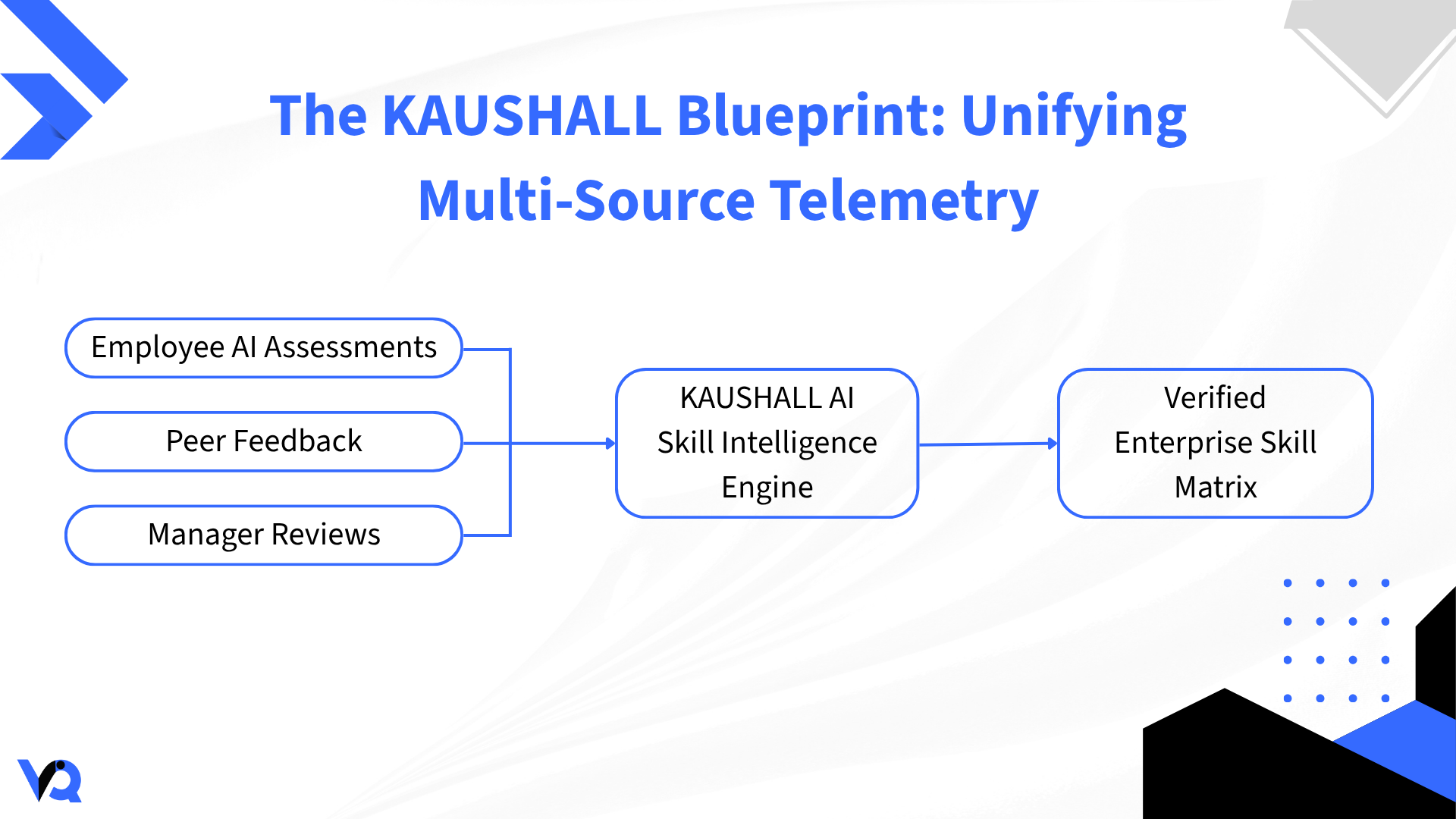
This is the exact operational layer engineered by KAUSHALL, an Human Capital Artificial Intelligence Platform. KAUSHALL bypasses the limitations of single-source screening by combining automated testing with a strict, multi-source evaluation loop. The platform establishes data integrity across the organization through three integrated pillars:
1. Contextual AI Assessment Testing
The evaluation begins with objective context. KAUSHALL automatically extracts the technical competencies and soft skills required for a specific role directly from bulk-uploaded job descriptions. When an evaluation cycle runs, the platform’s AI engine cross-references an employee’s resume with their active job requirements to generate ten deeply tailored, role-relevant situational questions, creating an un-gameable performance baseline.
2. Bias-Free Peer Feedback loops
An employee's peers know their strengths and workflow bottlenecks better than anyone. KAUSHALL includes a dedicated Peer Review System that allows team members to provide natural language, free-text feedback. By completely stripping away restrictive, arbitrary numeric scales (such as rating a colleague a "3 out of 5"), the platform removes competitive scoring bias. KAUSHALL’s AI then parses the qualitative text to extract genuine capability trends.
3. Hierarchical Manager Analytics
Managers provide the critical alignment between daily execution and macro business goals. Through a dedicated manager workflow, leaders can execute individual or bulk reviews using natural language feedback. The platform's AI processes this text, balancing the manager's perspective against peer reviews and the employee’s assessment performance to generate an accurate, verified Skill Matrix.
Transforming Multi-Source Insights into Targeted Upskilling
A multi-source skill matrix is highly valuable because it transforms raw human capital data into precise, automated action.
Once KAUSHALL aggregates employee testing, peer feedback, and manager reviews, it instantly highlights real-time capability gaps and operational readiness risks. Rather than leaving HR leaders with a static diagnostic dashboard, the platform automatically orchestrates the solution.
By integrating natively with premier global learning ecosystems like Coursera and Udemy, KAUSHALL translates identified skill gaps into hyper-personalized, role-aligned upskilling pathways. Instead of navigating massive, unguided training catalogs, employees are automatically directed to the exact modules required to improve their proficiency. Progress is continuously tracked and re-validated across subsequent, structured assessment cycles, transforming corporate learning into a highly predictable, data-backed engine for growth.
The Paradigm Shift in Enterprise Talent Governance
Transitioning from self-reported data to a multi-source intelligence layer changes how an enterprise manages its workforce:
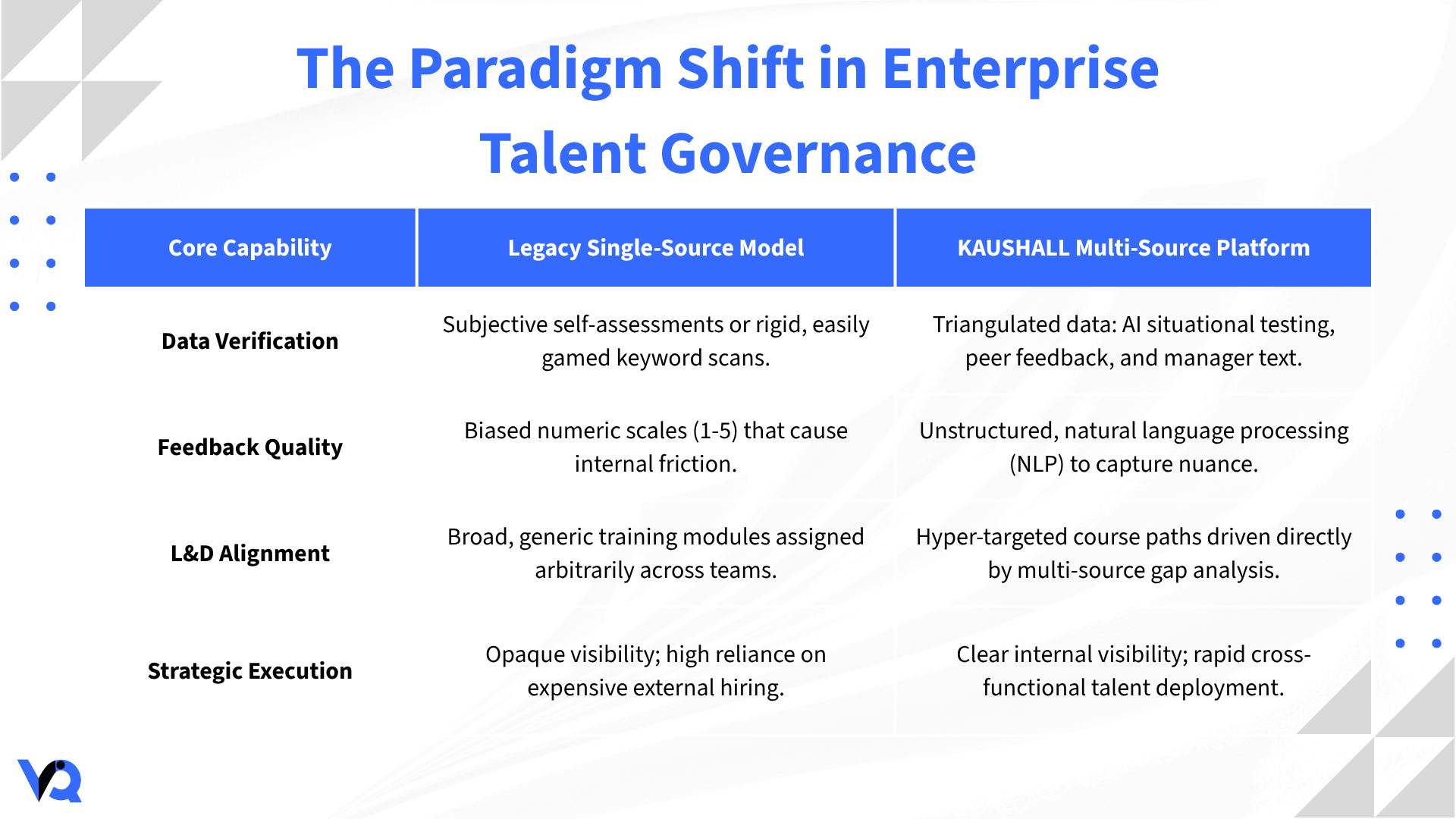
By leveraging KAUSHALL’s unified skills intelligence layer, CHROs, HR directors, and executive leaders can eliminate subjective blind spots, optimize their internal talent marketplace, and empower their workforce to drive continuous business growth.
Reference Links & Sources
- Deloitte Insights: Creating Value with Skills and the Skills-Based Organization Study
- McKinsey & Company: Taking a Skills-Based Approach to Building the Future Workforce
- Gartner Research: Top Strategic Priorities for Enterprise HR Leaders