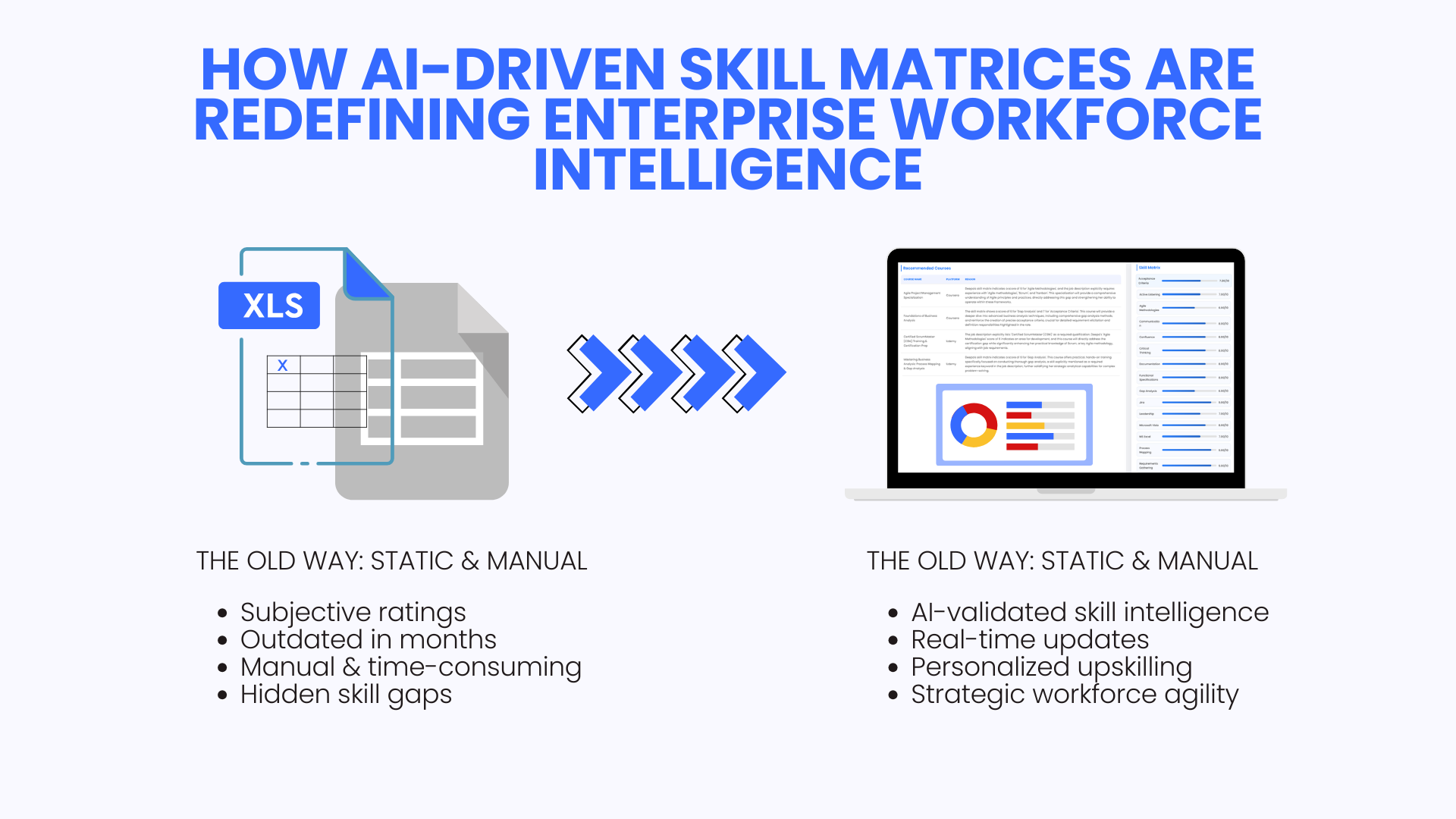
For decades, the standard tool for tracking organizational capability has been the humble, cell-shaded spreadsheet. When Chief Human Resource Officers (CHROs) or VPs of Talent needed to map team capabilities or prepare for a major digital transformation, HR teams typically built a massive grid, listed dozens of competencies down the left column, and sent it to managers to manually score their teams on a scale of 1 to 5.
While well-intentioned, this legacy process creates a stagnant artifact. The moment a manual skill matrix is saved and uploaded to a shared drive, it is already obsolete.
In an era defined by rapid market shifts and continuous technological disruption, relying on static spreadsheets is a significant risk. HR leaders cannot manage tomorrow’s growth using yesterday’s data. To achieve true organizational agility, enterprise talent strategy must move away from manual tracking and embrace a dynamic, AI-driven enterprise skill matrix.
The Fatal Flaws of the Manual Spreadsheet Matrix
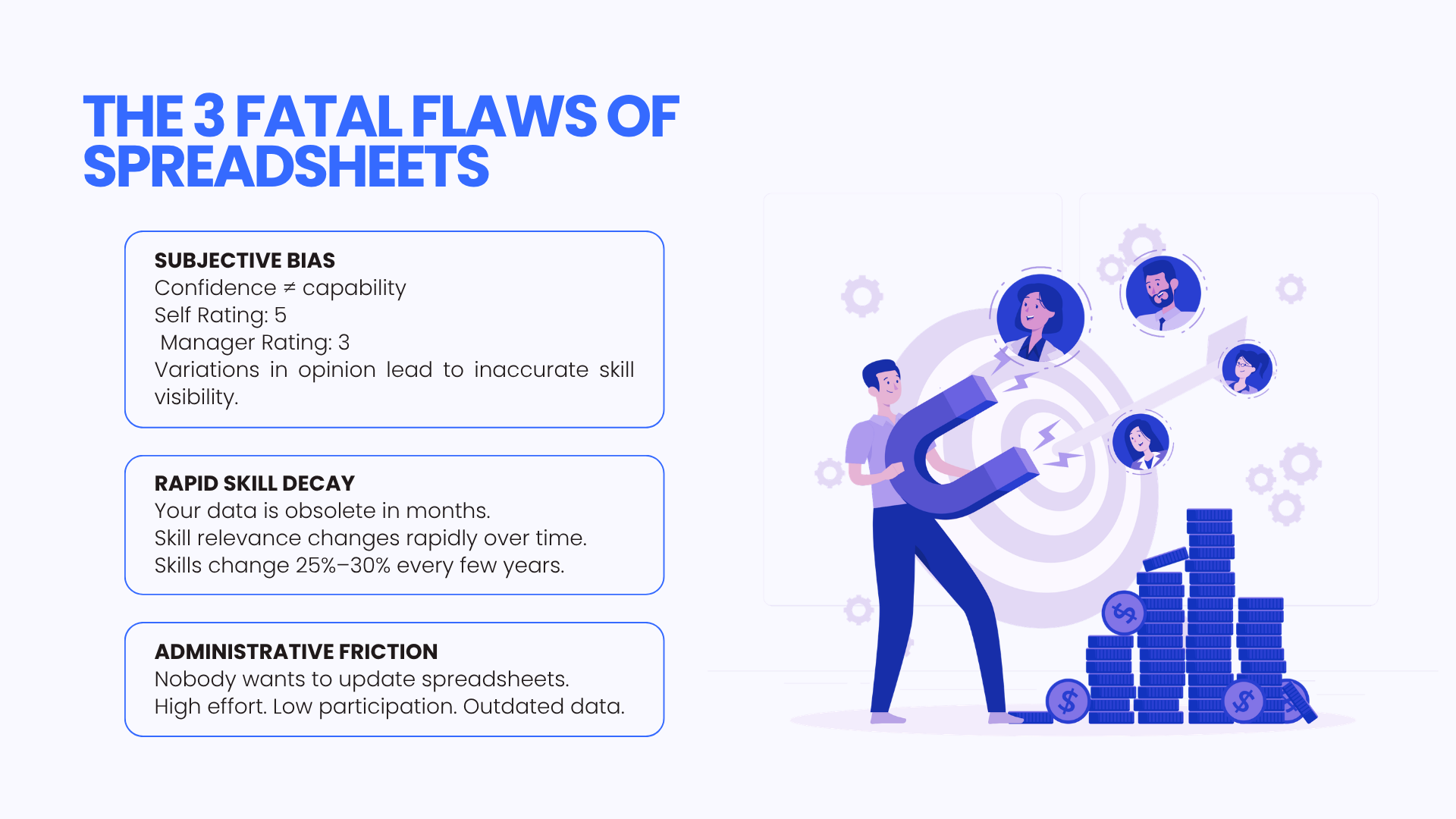
The traditional, manual approach to skill tracking fails enterprise organizations in three critical ways: subjective bias, rapid data decay, and administrative friction.
1. The Subjectivity Penalty
Manual skill matrices rely entirely on self-assessments or a single manager's opinion. This introduces massive variance. An assertive employee might rate themselves a "5" on data engineering, while a technically superior but humble peer rates themselves a "3." Without standardized verification, the spreadsheet captures confidence, not capability.
2. High Velocity of Skill Decay
Modern business capabilities expire faster than ever. According to research on workforce transformations by Deloitte, organizational skill requirements change by an estimated 25% to 30% every few years. A spreadsheet built six months ago cannot track the real-time upskilling or skill degradation happening across your engineering or product teams today.
3. Chronic Under-Participation
The administrative burden of updating an enterprise-wide matrix is immense. Employees view it as a tedious compliance exercise, and managers rush through it to return to their core duties. The result? Outdated data repositories that leadership cannot confidently use to deploy talent during critical strategic pivots.
The Strategic Cost of Operating Blind
Operating without an objective, real-time understanding of your workforce capability carries steep financial and operational consequences.
A comprehensive global workspace study by McKinsey & Company highlights that while 87% of executives acknowledge persistent skill gaps within their organizations, fewer than 30% feel confident they can identify and track those gaps effectively.
When a major company launches a new product line or expands into AI services, leadership often assumes they lack the talent internally and initiates expensive external recruitment drives. Meanwhile, latent, highly adjacent skills within their existing workforce remain completely hidden. This lack of intelligence results in bloated recruitment spend, extended time-to-market timelines, and high attrition among internal high-potentials who feel underutilized.
The Blueprint for an AI-Driven Skill Layer
Transitioning from a passive spreadsheet to a live talent engine requires a structural shift. Instead of treating skill data as an isolated compliance task, forward-thinking organizations use AI to build a unified skills intelligence layer.
This is where KAUSHALL transforms enterprise talent architecture.
KAUSHALL replaces speculative manual input with a continuous, multi-source data loop. The platform constructs a real-time, objective, and auditable enterprise skill matrix by unifying organizational context with multi-dimensional validation.
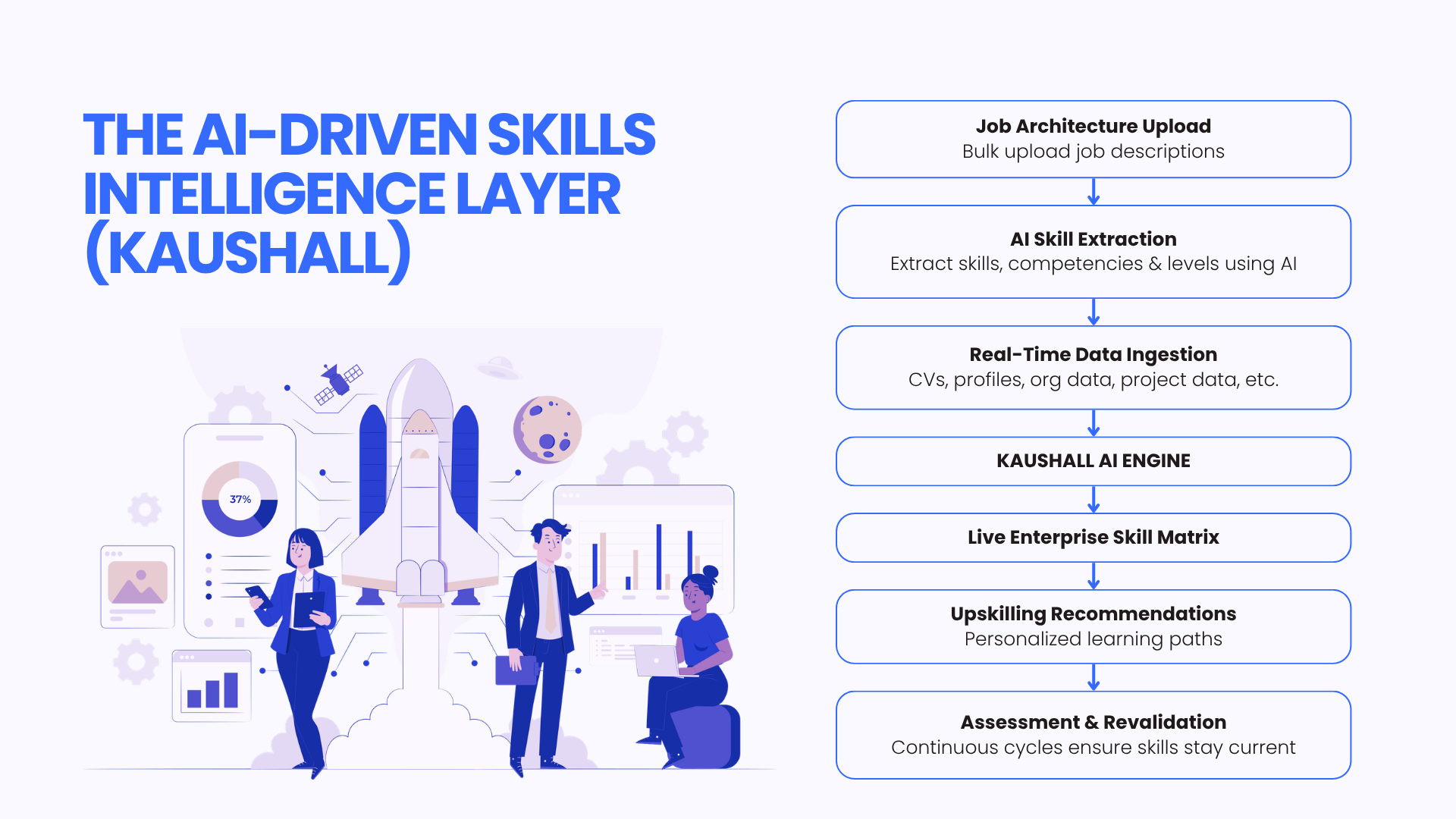
Building an intelligent enterprise skill matrix via KAUSHALL involves a streamlined four-step approach:
1. Structural Job Ingestion & Extraction
The process begins by converting static documentation into intelligence. HR teams can bulk-upload entire directories of job descriptions via predefined Excel templates. KAUSHALL automatically assigns standardized Job IDs and operational levels, while its AI engine breaks down the text to extract core technical competencies and soft skills into structured, reusable profiles.
2. Adaptive Context-Aware Assessment
Rather than asking employees to pick an arbitrary number from 1 to 5, KAUSHALL validates capability actively. The system cross-references an employee’s historical CV with their active job description. The AI engine then generates ten targeted, role-relevant situational questions. The employee's contextual answers are stored securely, creating a performance-based baseline of true execution readiness.
3. Natural Language Multi-Source Input
To eliminate individual manager bias, KAUSHALL introduces qualitative, multi-source evaluation loops. The platform allows peers and managers to provide unstructured, natural-language feedback. By stripping away restrictive numeric ratings and analyzing textual feedback instead, KAUSHALL’s AI extracts authentic sentiment and contextual capability markers that traditional forms miss completely.
4. Dynamic, Granular Leadership Dashboards
Once the evaluation cycle closes, the platform combines the assessment data, resume variables, and text feedback to generate a living Skill Matrix. HR directors can instantly drill down into workforce analytics across various dimensions:
- Organization-Level: Identify systemic readiness risks and macro skill trends.
- Department & Team-Level: Spot operational bottlenecks and compare capability benchmarks across different managers.
- Individual Employee-Level: Review verified proficiency ratings, complete assessment histories, and automated upskilling tracks.
Turning Matrix Insights into Continuous Upskilling
A skill matrix should do more than just diagnose problems, it must orchestrate the solution.
Traditional learning and development (L&D) programs often suffer from low engagement because training paths are disconnected from day-to-day work. KAUSHALL closes this loop completely. By connecting the live Skill Matrix directly to leading digital education platforms like Coursera and Udemy, the system translates identified skill gaps into hyper-personalized, role-aligned learning paths.
Instead of browsing a massive, unguided course catalog, employees receive precise, automated recommendations designed to move them to the next proficiency level. Progress is tracked and re-validated across subsequent, admin-controlled assessment cycles, giving CHROs a transparent dashboard to watch their organizational capability grow over time.
The Business Impact of Skills Intelligence
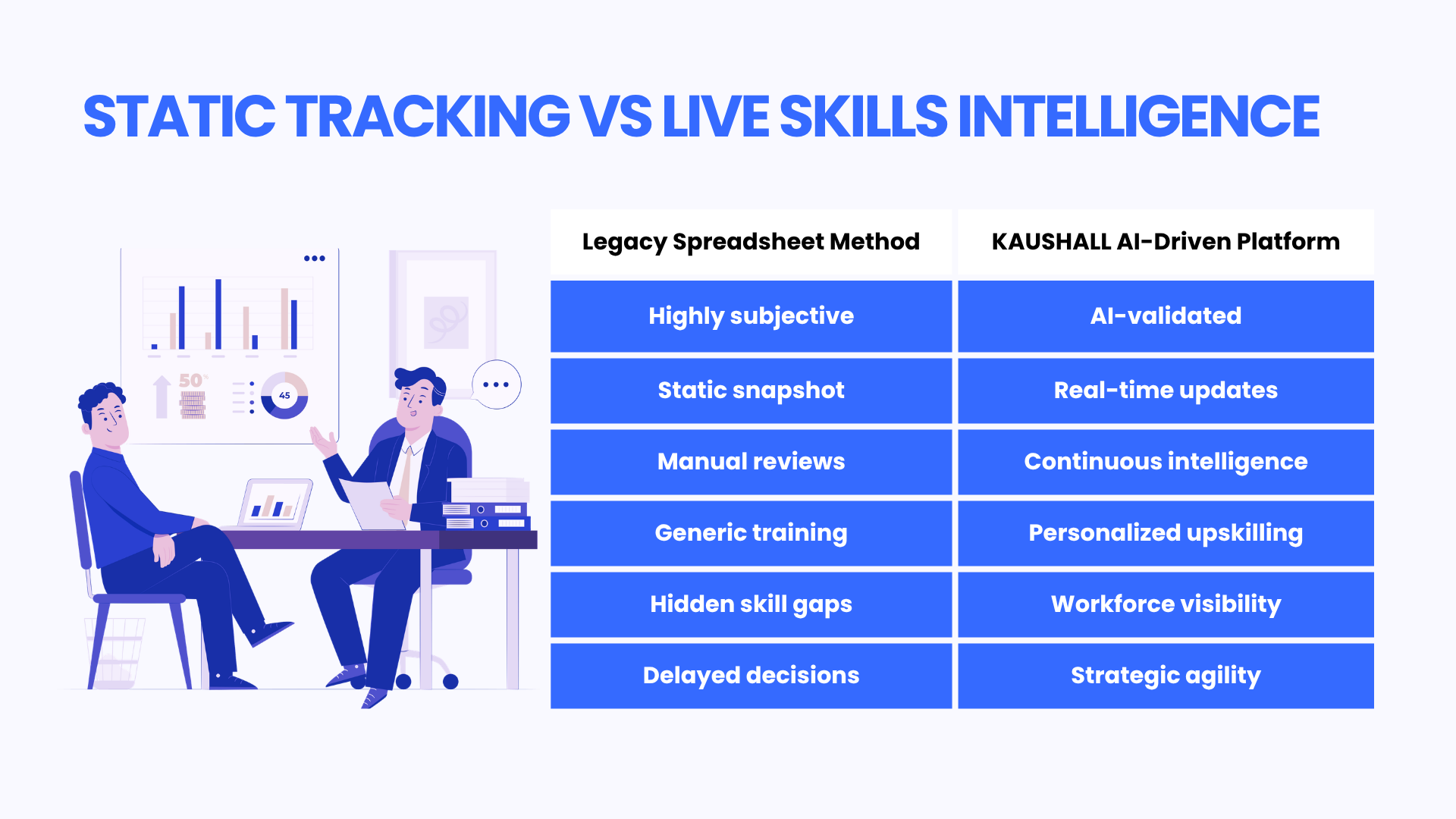
Transitioning from static spreadsheets to an AI-driven matrix unlocks a massive competitive advantage for the modern enterprise, as shown by comparative performance metrics:
| Operational Metric | Legacy Spreadsheet Method | KAUSHALL AI-Driven Platform |
|---|---|---|
| Data Accuracy | Highly subjective; prone to self-enhancement or manager bias. | Objective; validated via AI testing, resumes, and multi-source text. |
| Data Recency | Static snapshot; quickly outdated. | Dynamic; continuously updated through structured assessment cycles. |
| L&D Alignment | Disconnected; generic training modules assigned arbitrarily. | Direct; course recommendations are mapped to verified skill gaps. |
| Strategic Execution | Opaque; blind spots lead to external hiring or missed deadlines. | Transparent; leadership can instantly find the right talent for new projects. |
Research compiled by Gartner indicates that organizations that adopt a dynamic, skills-first talent model achieve a much higher level of organizational agility, allowing them to scale new services and reallocate internal resources far faster than competitors tied to legacy structures.
By implementing an AI-powered skills intelligence layer with KAUSHALL, CHROs and talent leaders can eliminate subjective blind spots, optimize their internal talent marketplace, and build a highly resilient, data-backed workforce ready for continuous scale.
Reference Links & Sources
- Deloitte Insights: Creating Value with Skills and the Skills-Based Organization
- McKinsey & Company: Taking a Skills-Based Approach to Building the Future Workforce
- Gartner: Top HR Priorities and Managing Enterprise Skill Gaps